
My son read every word out loud perfectly. Then I asked what it was about. He had no idea.
The six words his teacher said that explained two years of failed apps, wasted money, and nightly homework battles — and what finally fixed it.

The words come easy for a lot of kids. The part right after is where most get stuck.
below grade level
actually requires
this takes
guarantee
Last fall, my son Marcus read an entire page of his homework out loud without stopping once.
Every word. Perfectly. I remember thinking: we're finally turning a corner.
Then I asked him what it was about.
He looked up at me and said, "I don't know. I just read it."
If you've watched your own child do that — the words coming out fine, the comprehension coming up empty — you already know the small knot it leaves in your stomach.
And the fact that you're still reading this tells me something about you. You're the kind of parent who notices — and who refuses to look away.
Why it's so easy to miss — and why it matters nowFor the first few years, school is teaching kids how to read.
Then right around 3rd or 4th grade, it quietly flips. Now they're expected to read in order to learn everything else — the math word problem, the science chapter, the history page.
A child who reads the words but misses the meaning can coast right up to that line. Then every subject starts getting harder at once, and no one can say why.
If your child is already there, don't hear "too late." Hear "right on time." This is the window where catching it changes the most.
Maybe you've tried things. Maybe you're just starting to look.Some parents reading this have already been through the app, the workbook, maybe a tutor. Others are just starting to wonder if something's off.
Either way, hear this: the reason the things that get tried usually fail has nothing to do with your child's effort. Or yours.
In our case I tried all of it. The reading app Marcus opened twice and never touched again. A workbook phase where he filled in every answer and still couldn't tell me what the story was about when we were done. Then a tutor — $65 an hour, six weeks — who at the end told me, gently, that Marcus had "made progress with decoding" but his comprehension was "proving more complex."
Every night ended the same way. Me raising my voice. Him in tears. He started calling himself stupid. I started believing I'd failed him.
I was wrong about that. And if you've been telling yourself the same thing, so are you.
The conference I almost skippedIt wasn't until a parent-teacher meeting I nearly cancelled that someone finally explained it.
Marcus's teacher walked me through his latest assessment. She pointed to his fluency score. "He's actually doing really well here," she said. His numbers had gone up.
Then she pointed to the section below it. Comprehension. The numbers hadn't moved.
I asked her something I'd been afraid to ask for two years: Why? Why does he read every word perfectly and go completely blank when I ask what he just read?
She set down her pen.
"Fluency and comprehension are two completely separate skills," she said. "Most programs — and most schools, honestly — train one. They assume the other will follow. It doesn't."
I stared at her. "So the app, the workbooks, the tutor..."
"Were all training the same half," she said. "And a child who only has one will always hit a ceiling."
I sat in my car for a long time after that. The problem finally had a name. And the name wasn't "lazy." It wasn't "stupid." And it wasn't me.
Reading isn't one skill. It's two.There's reading the words — smooth and accurate, without stumbling or guessing. Teachers call that fluency.
And there's understanding them — who's in the story, what happened, why it matters. That's comprehension.
Most struggling kids are strong in one and stuck in the other. Some read slowly but understand everything. Some race ahead and remember nothing. Same gap. Opposite halves.
A child stuck here doesn't need more of one thing. They need both — practiced together, at the same time.
"My daughter was reading at a 2nd-grade level going into 4th. Six weeks with these and her teacher pulled me aside to ask what we changed. I cried on the way home. Worth every penny."
★★★★★ — Sarah M., Austin, TXI went looking for something that trained both halves together. Not another app. A system — two things designed to work side by side, the way reading actually works.
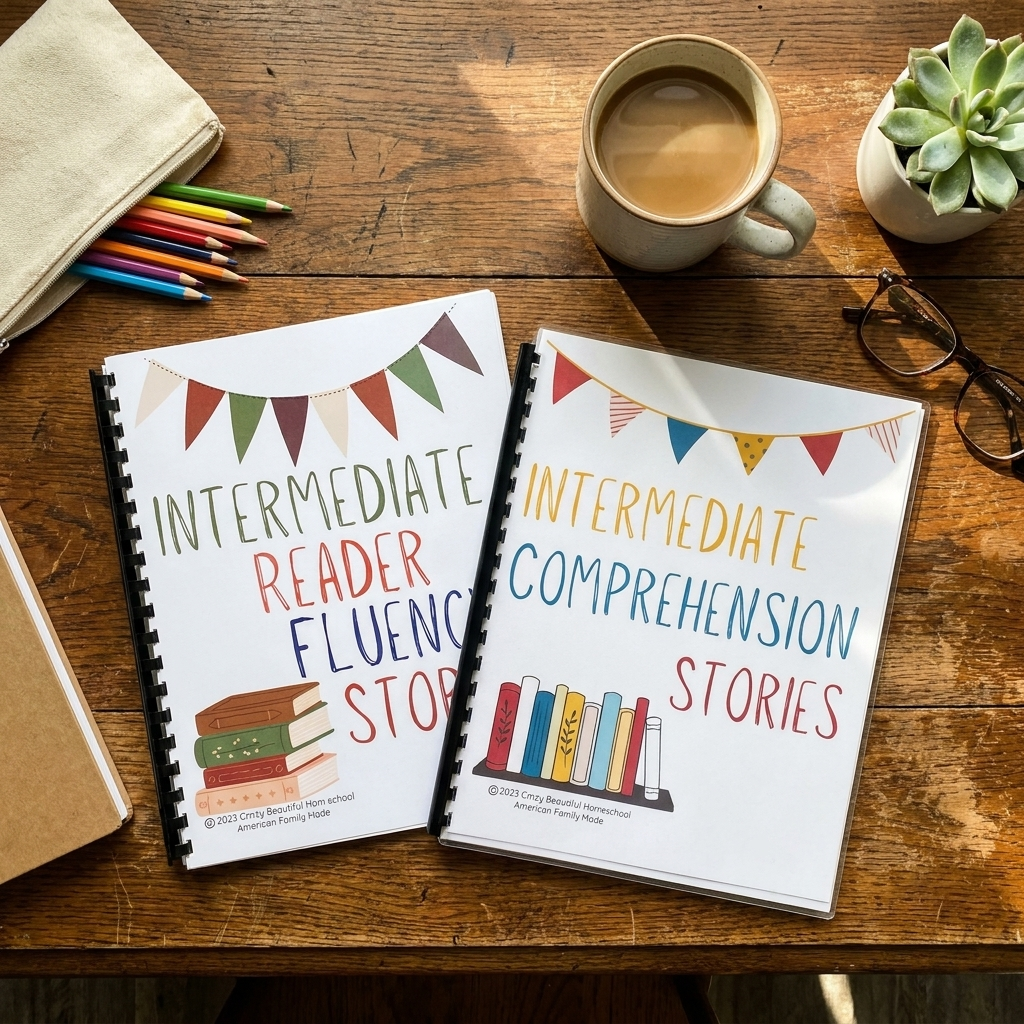
One book for fluency: short passages Marcus read aloud, getting smoother and faster each time. One book for comprehension: the same kind of passages, but with questions after that made him slow down and actually think about what he'd read.
Fifteen minutes. At the kitchen table. No teaching degree required. It didn't matter that Marcus is in a regular classroom while my sister uses the same two books to homeschool her daughter — same books, same fifteen minutes.
No diagnosis required. Just a kid who reads the words but loses the meaning.
We started on a Monday. Marcus didn't trust it at first — he'd been burned too many times to believe anything new.
But around day ten, he read a passage about a boy exploring a shipwreck. Then I asked him what happened.
He thought for a second. Then said: "The boy found a chest but was too scared to open it. He came back the next day."
That was the first time in two years Marcus had answered a comprehension question without guessing.
A few weeks later the nightly battles weren't harder or easier. They were gone. His teacher emailed me. I printed it out. It's still on my refrigerator.
He'd started believing he was a kid who could read. Because he was.
Here's what I want you to knowYou were never the problem. You're the one who kept looking when it would have been easier to quit.
That's the parent who catches this in time. That's the parent your child needs right now. And you're already her.
The two workbooks I used are from a company called Bright Pages — built for exactly this, for the readers who slip through right around 3rd and 4th grade, when it matters most.
15 minutes a day · Classroom or homeschool · No teaching experience needed
Parents who were exactly here
Excellent 4.9 / 5

"I've bought probably 4 different workbooks over the past year. This is the first one my son actually sits down and does without a fight. He's finally starting to get it and I can see his confidence building."
— Jamie S., Miami, FL"We homeschool and I was struggling to find something structured enough to actually move the needle. These were exactly what was missing from our curriculum. We do 15 minutes every morning and the difference is night and day."
— Nancy L., Seattle, WA"Bought the set for my twin boys, both in 3rd grade. One reads fine but struggles to explain what he read; the other reads slowly but understands everything. These fixed both problems at the same time."
— Jacob R., Toronto, ON"I bought this on a whim at 11pm after another homework battle. Two months later my son asked to be read to before bed — without being asked. I didn't think a workbook could do that."
— Tanisha M., Verified BuyerFree shipping · 30-day money-back guarantee
Advertisement
This is an advertisement and not a news article or editorial. The story and person depicted are illustrative and based on the experiences of customers who have used this product. Names and details have been changed.
Customer reviews reflect individual experiences and results may not be typical. Bright Pages is a supplemental reading practice product and is not a diagnosis, treatment, or substitute for professional educational assessment.
© 2026 Bright Pages. All rights reserved.